A book sized to the problem
How independent publishers can decide whether a focused nonfiction edition should be short, expansive, practical, or layered by following the shape of the reader’s problem.
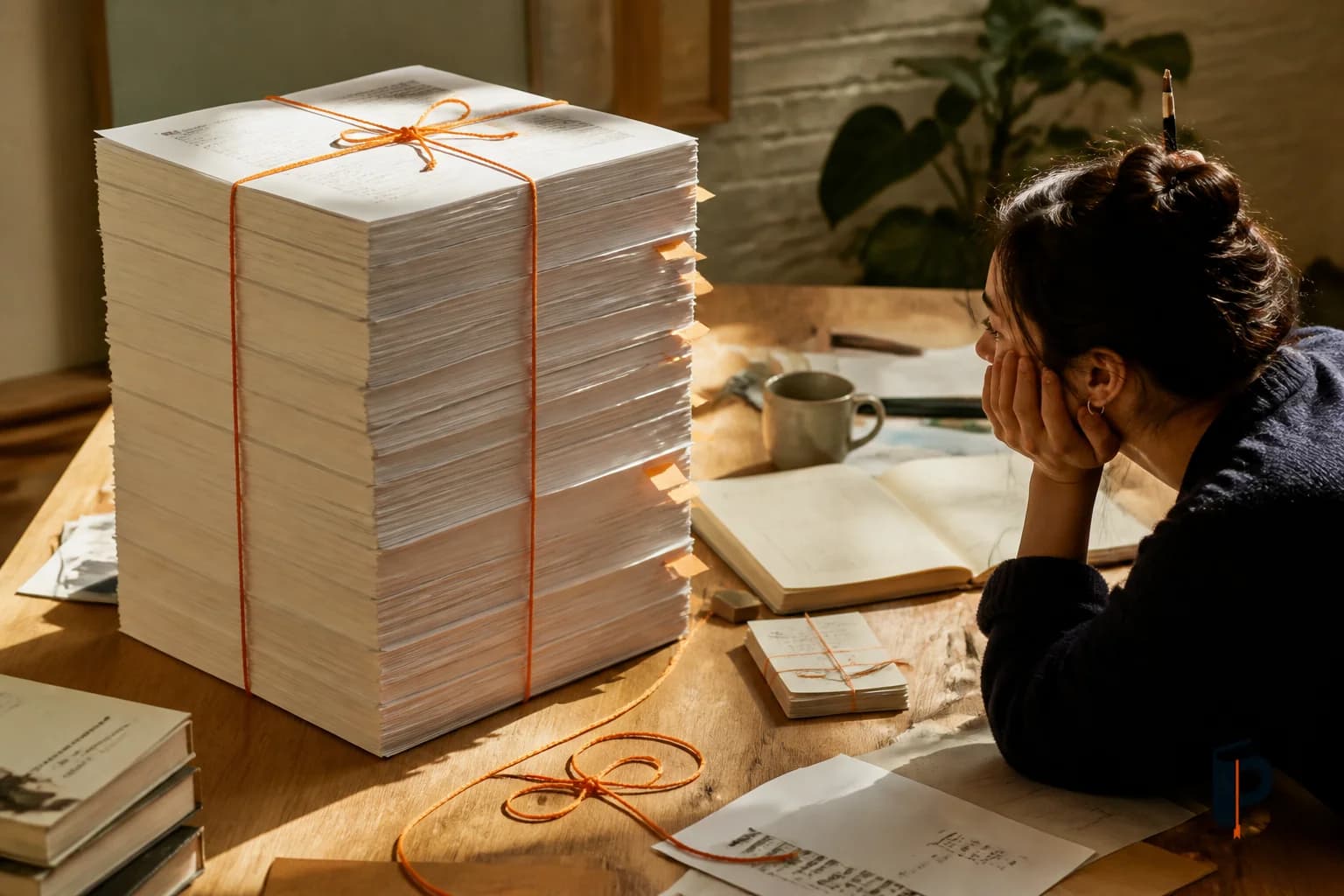
A focused book does not need to be large to be serious.
It needs to be proportionate.
The useful question is not, “How long should this be?” It is, “What size does this problem require before a reader can move through it with more clarity than they had before?”
That question changes the work. It moves the publisher away from padding, compression, and borrowed formats. It brings the edition back to the reader, the decision in front of them, and the amount of structure the problem truly needs.
Where the size of the book begins
A book is often imagined as a container first: a page count, a trim size, a table of contents, a promise on a cover. But in practical nonfiction, the container should arrive later.
The beginning is the problem.
Some problems are narrow but consequential. A reader may only need fifty careful pages, a few examples, and a checklist they can trust. Other problems are layered. They involve tradeoffs, vocabulary, uncertainty, sequence, and judgment. Those problems may need chapters that slow down the reader’s rush toward a conclusion.
The size of an edition should follow the density of the thread, not the publisher’s appetite for volume.
A short book can still be deep if it removes noise with care. A longer book can still be practical if each chapter earns its place. What matters is whether the reader feels the structure meeting the problem at the right scale.
When a quick answer leaves too much behind
Search results are useful when the question is simple. They are less useful when the reader is trying to make sense of a decision with consequences.
A quick answer can name the obvious. It can define a term, summarize a method, or offer a starting point. But many reader problems do not end at the starting point. They continue into comparison, sequencing, risk, context, and application.
That is where a focused edition becomes useful.
It does not merely collect advice. It makes a path through the advice. It shows what to read first, what to ignore, what depends on context, and what a reader should decide before moving forward. In that sense, book length is not a prestige signal. It is a design choice.
We have written before about The Work A Quick Answer Cannot Do. This is the companion question: once the quick answer is no longer enough, how much book does the problem deserve?
The reader is not asking for pages
Readers rarely want more material for its own sake. They want less confusion.
A reader may arrive with scattered notes, saved articles, conflicting opinions, half-remembered advice, and a feeling that they are missing the shape of the issue. They may not know whether their problem is strategic, technical, emotional, creative, financial, or some mixture of all five.
The edition has to respect that state.
If the book is too thin, it may leave the reader with a list of statements but no system. If it is too broad, it may bury the useful thread under background, history, and adjacent topics. If it is too rigid, it may flatten a problem that requires judgment.
Good editorial sizing asks: what does the reader need to understand, compare, practice, or decide before the book has done its job?
That answer may produce a compact guide. It may produce a workbook with field notes. It may produce a sequence of chapters, frameworks, worksheets, and practical examples. The form is earned by the problem.
What belongs in the edition
A focused edition should include what helps the reader move from uncertainty toward usable clarity.
That usually means a few kinds of material working together:
- a plain description of the problem;
- the key distinctions the reader must understand;
- the recurring patterns that create confusion;
- the decisions that shape the reader’s next move;
- examples that make the idea less abstract;
- a framework for sorting options;
- a checklist or worksheet that helps the reader apply the material;
- a closing synthesis that shows what now becomes possible.
Not every edition needs all of these in equal measure. A concept-heavy problem may need more language and framing. A decision-heavy problem may need more comparison and tradeoffs. A process-heavy problem may need steps, checkpoints, and companion tools.
The editorial question is not, “What else can we add?” It is, “What would make the reader’s next decision clearer?”
For a related starting point, The Decision Before The Outline looks at the moment before structure becomes chapters.
The noise that makes a book too large
Books become bloated when the publisher confuses surrounding information with necessary information.
A few common mistakes appear early:
- keeping every research note because it took effort to find;
- adding background that satisfies the author more than the reader;
- repeating the same idea in new language without increasing clarity;
- including adjacent topics because they are interesting;
- turning simple tools into complicated systems;
- stretching a compact insight into a full-length argument.
There is also an opposite mistake: making the book too small because the publisher wants it to feel efficient.
Efficiency is not the same as usefulness. A reader with a difficult problem may need patience, not abbreviation. They may need to see the same issue from two angles. They may need an example, then a counterexample, then a checklist. They may need the book to slow them down just enough to prevent a poor decision.
A focused edition should not be thin or swollen. It should be shaped.
Questions before the page count hardens
Before deciding whether a concept deserves a short guide, a full edition, or a more layered catalog entry, it helps to sit with the problem directly.
Useful questions include:
- What is the reader trying to decide, build, change, understand, or repair?
- Where does scattered advice make the problem harder instead of easier?
- Which distinctions would immediately reduce confusion?
- What does the reader need to know before the practical steps make sense?
- Which examples would make the problem feel real?
- What can be removed without weakening the reader’s understanding?
- Where does the reader need a framework rather than another opinion?
- What tool, worksheet, or checklist would support the book without replacing it?
- What would make the edition feel complete without making it heavy?
These questions keep the publisher close to the reader’s actual need. They also prevent the book from becoming an argument for its own existence.
A quieter checklist
A book is probably sized well when:
- the opening names the problem clearly;
- each chapter answers a necessary part of the reader’s confusion;
- examples carry weight rather than decoration;
- the structure creates momentum without rushing;
- the practical tools support the text instead of standing in for it;
- the ending leaves the reader with a better way to think and act;
- no section exists only because books of this kind usually include it.
A book is probably mis-sized when the reader can feel the scaffolding more than the insight. Too much framework can become furniture. Too little structure can become fog.
The best editions feel considered. The reader may not notice every editorial choice, but they feel the result: fewer loose ends, fewer distractions, and a clearer path through the problem.
From the publisher
At Piko Thread Editions, we are interested in books that earn their shape.
That means resisting both the quick answer and the overbuilt manual when neither one fits. Some threads need a small, exact guide. Some need a deeper room. Some need companion tools, field notes, and a structure that helps the reader return to the material more than once.
The work is to listen for the size of the problem before deciding the size of the book.
A useful edition does not prove its value by being long. It proves its value by helping the reader see what matters, leave behind what does not, and carry a clearer system into the next decision.
If you are following the larger catalog of problem-centered books, you can find more from Piko Thread Editions at pikothreadeditions.com.
Publisher note
Piko Thread Editions starts with the problem, not the format. The goal is not to make more books. The goal is to follow a question carefully enough that the finished edition gives the reader structure, clarity, and useful next steps.