The questions sturdy enough for a book
A calm framework for deciding when a question has enough depth, friction, and reader consequence to become a focused practical nonfiction book.
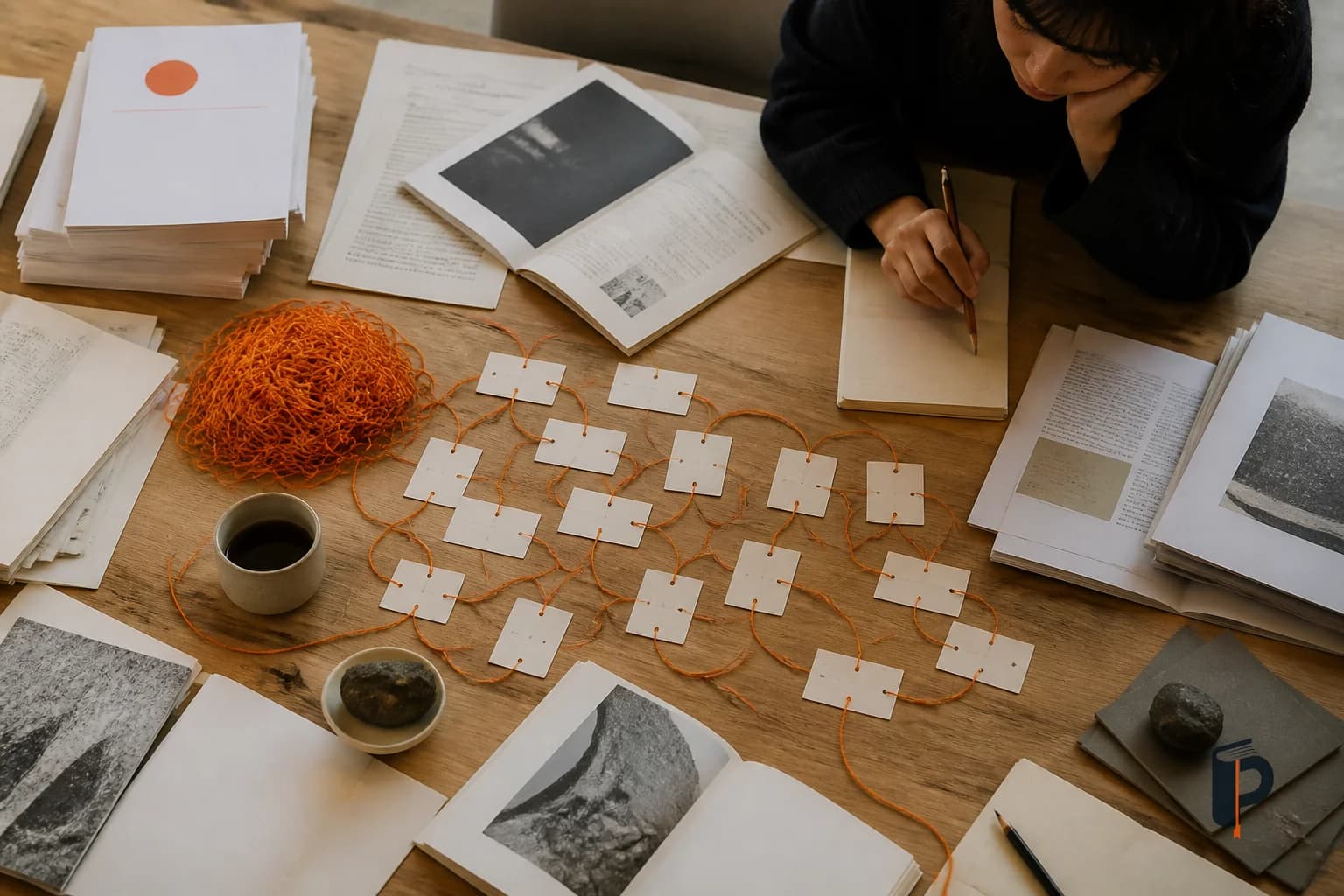
A book does not need to begin with a large subject. More often, it begins with a question that keeps proving sturdier than expected.
It survives the first answer. It survives the second opinion. It gathers edge cases, tradeoffs, examples, and decisions. At some point, the work is no longer to answer the question quickly. The work is to build a clear enough room for the reader to think inside.
Where the thread first tightens
A question becomes sturdy when it has weight on both sides: enough uncertainty to require exploration, and enough practical consequence to matter.
Not every interesting question deserves a book. Some are better as a note, a checklist, a conversation, or a short article. The difference is not prestige or page count. The difference is what the reader must understand before they can act with care.
A sturdy question usually has a few signs. It appears in different forms across different readers. It resists being solved by one expert quote. It contains decisions that depend on context. It has language problems as much as information problems: people are not only missing facts, they are missing a way to name what is happening.
That is where a focused edition can help. It does not inflate the question. It gives the question a structure strong enough to carry the research.
For a related starting point, see When a problem is worth a book.
When advice starts to feel too thin
Scattered advice often looks useful at first. It gives the reader movement. It offers a phrase, a step, a rule of thumb. But if the problem has depth, the advice begins to fray.
One answer assumes a beginner. Another assumes resources the reader does not have. One framework works in a simple case but breaks under pressure. A popular checklist skips the messy middle. A confident recommendation hides the decision it is really making for the reader.
This is the moment a publisher should slow down.
The reader is not asking for more fragments. They are asking for orientation. They need to see the landscape: what matters, what does not, what changes by situation, what order to think in, and where good judgment enters.
A book earns its shape when it can replace a pile of partial answers with a coherent path through the problem.
What the book has to carry
A sturdy question asks for more than explanation. It asks for editorial choices.
The first choice is scope. A useful practical book does not try to cover the entire universe around a subject. It draws a boundary around the reader’s real problem. It says: this is the decision space we are working in, and this is what we will leave outside.
The second choice is sequence. Readers rarely need information in the order the publisher found it. Research may arrive as a mess of notes, interviews, examples, and saved links. The book has to rearrange that material into a path the reader can follow.
The third choice is texture. A sturdy question benefits from examples, contrasts, field notes, worksheets, and small tests of understanding. These are not decorations. They help the reader translate the system into their own circumstances.
The fourth choice is restraint. A focused edition should not prove how much the publisher knows. It should prove that the publisher knows what belongs.
When a thread begins to need sequence, When the thread needs a structure may be the next useful companion.
Where the noise sneaks in
The most common mistake is confusing quantity with depth. A long manuscript can still be shallow if it only stacks information. A short book can be deep if it helps the reader make better distinctions.
Another mistake is mistaking market familiarity for reader need. A topic may be popular because people search it often, but the stronger question is whether readers leave those searches with clarity. If they return again and again, the issue may not be demand alone. It may be unresolved structure.
A third mistake is building from the publisher’s curiosity instead of the reader’s decision. Curiosity matters. It keeps the research alive. But a Piko-style edition must eventually ask: what will the reader be better able to see, sort, decide, or do after this book?
Finally, there is the mistake of adding companion tools too early. A worksheet, checklist, or framework can support a book beautifully. But if the tool arrives before the thinking is clear, it becomes a container for confusion. The book should make the tool useful, not the other way around.
Questions before the edition exists
Before treating a question as a book, it helps to sit with it in plain language.
What decision is the reader trying to make?
What makes that decision harder than it first appears?
Where does common advice become too general, too confident, or too incomplete?
What does the reader need to understand before a checklist would be useful?
Which distinctions would reduce confusion most quickly?
What examples would make the problem visible?
What should this book refuse to cover so the main thread stays clear?
These questions do not create a manuscript by themselves. They create pressure. They show whether the idea has enough inner structure to become an edition rather than a loose collection of notes.
A quieter checklist
A question may be sturdy enough for a book when:
- readers encounter the same confusion from several directions
- existing advice answers pieces but not the whole decision
- the problem has meaningful tradeoffs, not just steps
- examples change how the reader understands the issue
- a clear sequence would reduce overwhelm
- research reveals patterns rather than isolated tips
- the book can define what belongs and what does not
- companion tools would support the reader after the chapters have done their work
This checklist is not a gate. It is a pause. It asks the publisher to notice whether the question is asking for depth or merely asking for attention.
From the publisher
At Piko Thread Editions, we are interested in books that earn their reason to exist. That standard is not about making everything serious or heavy. It is about respecting the reader’s attention.
A good focused edition should feel like someone has pulled the thread carefully: finding the real problem, separating signal from noise, arranging the research, and leaving the reader with a system they can return to.
Some questions are light enough to answer quickly. Some need a page. Some need a tool. And some need chapters because the reader is not only looking for information. They are looking for a steadier way through.
The room a reader can use
The best sign is often quiet. The question keeps coming back, but not because the answer is hidden. It comes back because the answer needs shape.
That is the work of the book: not to make the problem bigger, but to make it clearer.
If you want to follow more threads like this, visit Piko Thread Editions and explore the catalog as it grows.
Publisher note
Piko Thread Editions starts with the problem, not the format. The goal is not to make more books. The goal is to follow a question carefully enough that the finished edition gives the reader structure, clarity, and useful next steps.